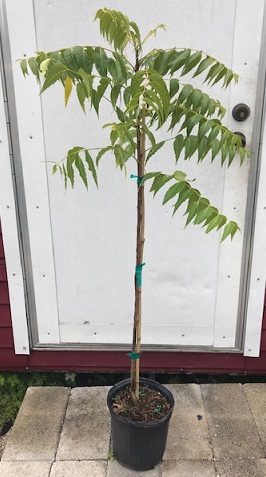
Sugarberry is a beautiful Florida native. It is a large, fast-growing, deciduous tree. The light green leaves turn bright yellow in the fall and fruits are eaten by a number of birds. It grows best in full sun with moderate to moist soil, but is salt tolerant and will tolerate drought once established. Sugarberry can be recognized by its bark, which is covered with small bumps, gray/brown/silver in color, thin and smooth. It is the larval host for a number of butterflies and the sole larval host plant for American snout (Libytheana carineta) butterfly in South Florida.
How to care for Sugarberry
Light. Grows best in full sun and tolerates partial shade.
Water. Water regularly until established. After that it handles dry spells fairly well, and it also grows well on wet sites.
Soil and feeding. Grows in many soils but does best in moist, fertile soil with some organic matter. Highly alkaline soil can turn the leaves yellow (chlorosis).
Size. A fast-growing tree, 50 ft or more; open-grown trees commonly reach 50–70 ft with a similar spread. Its roots can grow large at the surface, so give it room.
Pruning. Needs skilled pruning several times in its first 15 years to build one strong trunk. Avoid cutting large limbs off the trunk, since it seals off decay poorly.
Problems to watch. Protect the trunk from injury, which leads to trunk rot. Leaf galls, leaf spots and scale are usually minor.
Good to know. A Florida native and a larval host for American snout, hackberry emperor, tawny emperor and question mark butterflies. Birds eat the sweet fruit.
Sources: UF/IFAS EDIS ST138: Celtis laevigata: Sugarberry · Natives for Your Neighborhood (Institute for Regional Conservation): Celtis laevigata · Florida Native Plant Society Plant Database: Celtis laevigata